
Gold Purchasing Power: What A Home Costs in Ounces of Gold
The comments below are an edited and abridged synopsis of an article by Mining Visuals
Gold purchasing power: What a home costs in ounces of gold
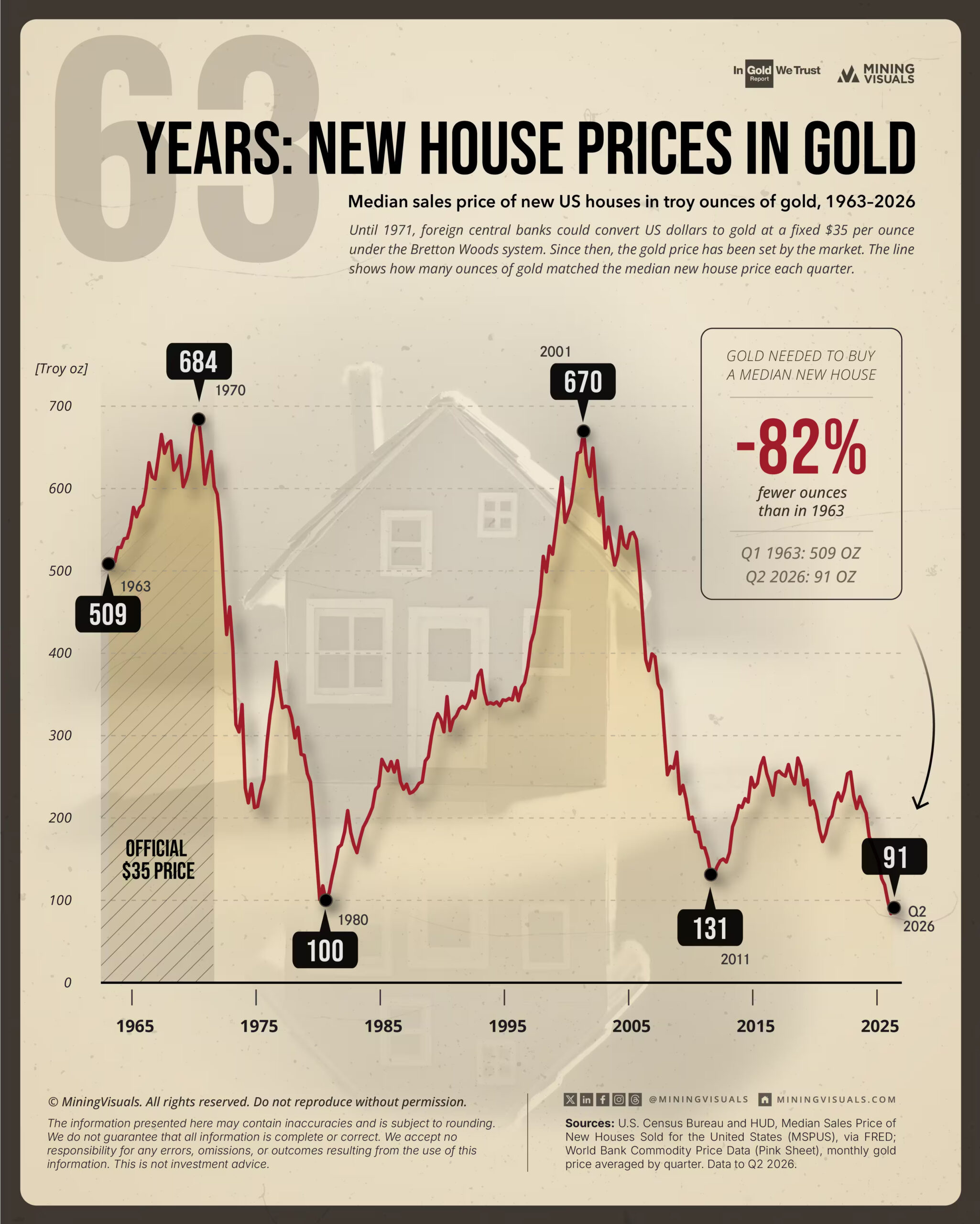
Gold purchasing power offers a different way to view the value of money and real assets. A recent analysis by Mining Visuals found that a median new US home cost fewer than 100 ounces of gold in each quarter from Q4 2025 through Q2 2026. According to the analysis, this is the first time in 63 years of available data that the ratio has remained below 100 ounces.
Looking beyond the dollar price
Most people measure the value of a home in dollars. This is the standard approach, but it does not tell the entire story.
The US median price of a newly built home was $393,800 in July 2026. In dollar terms, new-home prices have remained within a relatively narrow range in recent years. When measured against gold, however, the picture is very different.
In Q2 2026, the median new home cost about 91 ounces of gold. That compares with 84 ounces in Q1. The change was largely due to a pullback in gold from its Q1 average, rather than a major increase in home prices.
This highlights an important feature of gold purchasing power. The measure looks at what gold can buy rather than simply what gold is worth in a particular currency.
A long-term perspective
The historical comparison is even more striking.
In the late 1960s, gold was still closely tied to the Bretton Woods monetary system. The US dollar was exchangeable for gold at $35 an ounce for official transactions. During that period, housing prices increased while the price of gold remained relatively fixed. As a result, the number of ounces required to purchase a new home climbed to a peak of 684 ounces in 1970.
The relationship changed dramatically when gold began to rise.
From 1970 to 1980, the median new-home price increased 166%. Gold, however, rose about 18-fold. The number of ounces required to purchase a home therefore fell sharply. A similar pattern developed between 2001 and 2011, when gold increased more than sixfold while home prices rose at a much slower pace.
What is driving the latest change?
The recent decline in the home-to-gold ratio has been driven largely by gold’s strong performance. Between Q2 2025 and Q2 2026, the median new-home price fell 1.3%, while the quarterly average gold price increased 37%, from $3,293 to $4,512 an ounce.
Housing conditions have also played a role. Builders have reduced prices and offered incentives to attract buyers. They have also been building more smaller, lower-priced homes, which has helped reduce the median selling price.
This distinction is important. A lower home-to-gold ratio does not mean housing has suddenly become inexpensive. It means that gold’s purchasing power relative to this particular asset has increased.
Why gold purchasing power matters
For long-term investors, gold purchasing power can provide a useful perspective on wealth. Rather than asking only how much gold has risen in dollars, investors can consider what physical gold can purchase over time.
A house is a tangible asset. Gold is a tangible monetary asset. Comparing the two can offer insight into changes in relative value that may be hidden when everything is measured only in currency.
The latest data provide an interesting historical milestone. A median new US home has now cost fewer than 100 ounces of gold for three consecutive quarters—the first time this has occurred in the available 63-year record.
For investors focused on long-term wealth protection, gold purchasing power is therefore a measure worth watching alongside the gold price itself.
BMG Note: What Can Your Money Actually Buy?
Most investors look at gold through its price in dollars. But there is another, often more meaningful, way to look at it: What can gold buy?
The recent comparison between the price of a new US home and the amount of gold needed to buy it provides a simple way to understand this concept.
A median new home in the US has recently cost less than 100 ounces of gold. That may sound surprising, but the bigger lesson is not about houses or even the gold price. It is about purchasing power.
Think of it this way: If you keep $100,000 in the bank for a decade, the number on your bank statement at the end of that decade may still be $100,000, but what that $100,000 can buy may be very different. Inflation gradually reduces the purchasing power of currency as the cost of goods, services and assets rises.
Gold offers a different measuring stick.
Rather than asking, “How much is gold worth in dollars?” we can ask, “How much of something important can my gold buy?”
A home is a useful example because it is a tangible asset that people understand. Over long periods, the number of ounces of gold required to purchase a home has changed significantly. These changes reflect the relative purchasing power of gold compared with currency and other assets.
Importantly, this is not a prediction that gold will rise or that housing prices will fall. It is simply another way to understand the role gold can play in preserving purchasing power.
For the everyday investor, this distinction matters. Currency is designed to be spent and used as a medium of exchange. Gold is a tangible asset that has been used as a store of value for thousands of years. Looking at gold against real-world assets can help investors see beyond the daily dollar price and consider the bigger picture.
At BMG, we believe this is one of the most useful ways to think about ownership of physical gold. The goal is not simply to watch the gold price move higher in Canadian or US dollars. The broader question is what that physical gold may represent in terms of purchasing power over time.
Gold does not need to replace other investments. Instead, ownership of physical precious metals can provide diversification and another form of wealth protection at a time when the purchasing power of currencies can change.
Sometimes the simplest comparison tells the most important story.
Instead of asking only what your money is worth, ask what your money can buy.
That is where the comparison between gold and currency becomes particularly powerful.