

US Financial Crisis: Debt, Fed Policy and Market Risks
The comments below are an edited and abridged synopsis of an article by Ambrose Evans-Pritchard
US Financial Crisis: Debt, Fed Policy and Market Risks
Concerns about a potential US financial crisis are intensifying as high government debt, growing refinancing requirements and increasing dependence on short-term funding expose vulnerabilities within the American financial system. An analysis by Ambrose Evans-Pritchard argues that several warning signs are converging, although a crisis would still require a significant trigger.
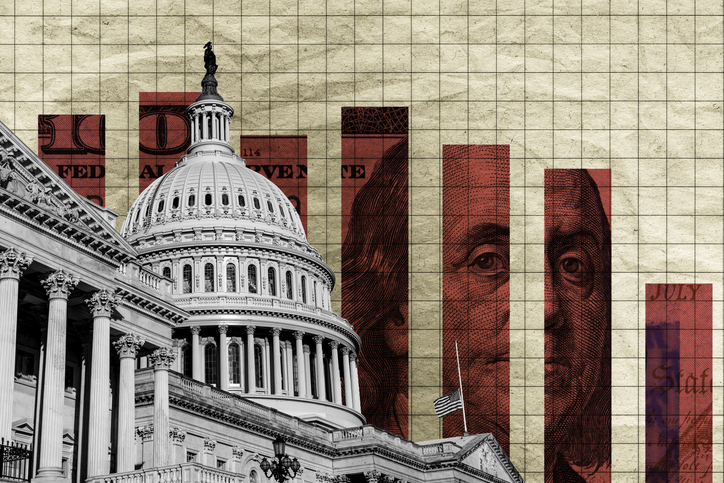
The main focus of concern is the scale and structure of US government borrowing. The US Treasury must refinance approximately US$6 trillion of debt every three months while issuing another US$2 trillion annually to help finance the country’s structural deficit. The International Monetary Fund estimates that annual gross financing requirements could reach 45% of GDP in 2026, and potentially 60% by the early 2030s, if current policies remain unchanged.
The situation is further complicated by the Treasury’s increasing reliance on short-term bills. While this approach can temporarily contain borrowing costs, it also leaves government finances more exposed to changes in interest rates. National debt interest costs have reportedly quadrupled over the past decade to approximately US$1 trillion annually, surpassing defence spending.
Another important component of the potential US financial crisis is the changing investor base for Treasury securities. Hedge funds have significantly increased their participation, accounting for about 9% of Treasury purchases. Some funds use substantial leverage through the repo market to pursue arbitrage opportunities. The IMF and Bank for International Settlements have previously warned that this structure can amplify forced selling during periods of market stress, as demonstrated during the March 2020 Treasury market disruption.
Monetary policy presents another challenge. New Federal Reserve Chair Kevin Warsh faces pressure to balance persistent inflation against the potentially destabilizing effects of higher interest rates. With a substantial portion of federal debt requiring frequent refinancing, materially higher rates could quickly increase the government’s financing costs. At the same time, failing to respond adequately to inflation could further undermine confidence in monetary policy.
The analysis also highlights the growing influence of artificial intelligence and the possibility of an AI-driven market bubble. Warsh has suggested that productivity gains from AI could prove deflationary, potentially allowing stronger economic growth without equivalent inflation. Critics, however, question whether this argument sufficiently addresses current inflationary pressures.
Beyond debt and monetary policy, persistent fiscal deficits, expanding government programs and increased defence spending are adding to the long-term pressure. The IMF expects the US general government deficit to remain at 7.4% of GDP or higher annually through 2031.
Ultimately, the author does not suggest that a US financial crisis is inevitable. Rather, it argues that the ingredients are increasingly present. The United States retains considerable economic strength and benefits from the dollar’s reserve-currency status, but rising financing needs, leveraged Treasury markets, fiscal deterioration and questions surrounding policy credibility could create a more fragile environment.
As the article notes, financial crises can develop slowly before accelerating rapidly once confidence breaks. For investors, the warning is that the combination of fiscal pressures, monetary policy uncertainty and market leverage deserves close attention.