

Gold vs the Erupting Financial Volcano: Why Systemic Debt Stress Is Driving a New Monetary Regime
The comments below are an edited and abridged synopsis of an article by Tyler Durden. Authored by Matthew Piepenburg via VonGreyerz.gold
The gold vs erupting financial volcano analysis frames today’s global financial system as a structure under mounting internal pressure, where surface-level market stability conceals deep and accelerating systemic stress. The central argument is that the global economy is approaching a critical inflection point driven by excessive debt, volatile energy dynamics, and increasingly unstable bond markets, with gold emerging as the primary defensive asset in this evolving environment.
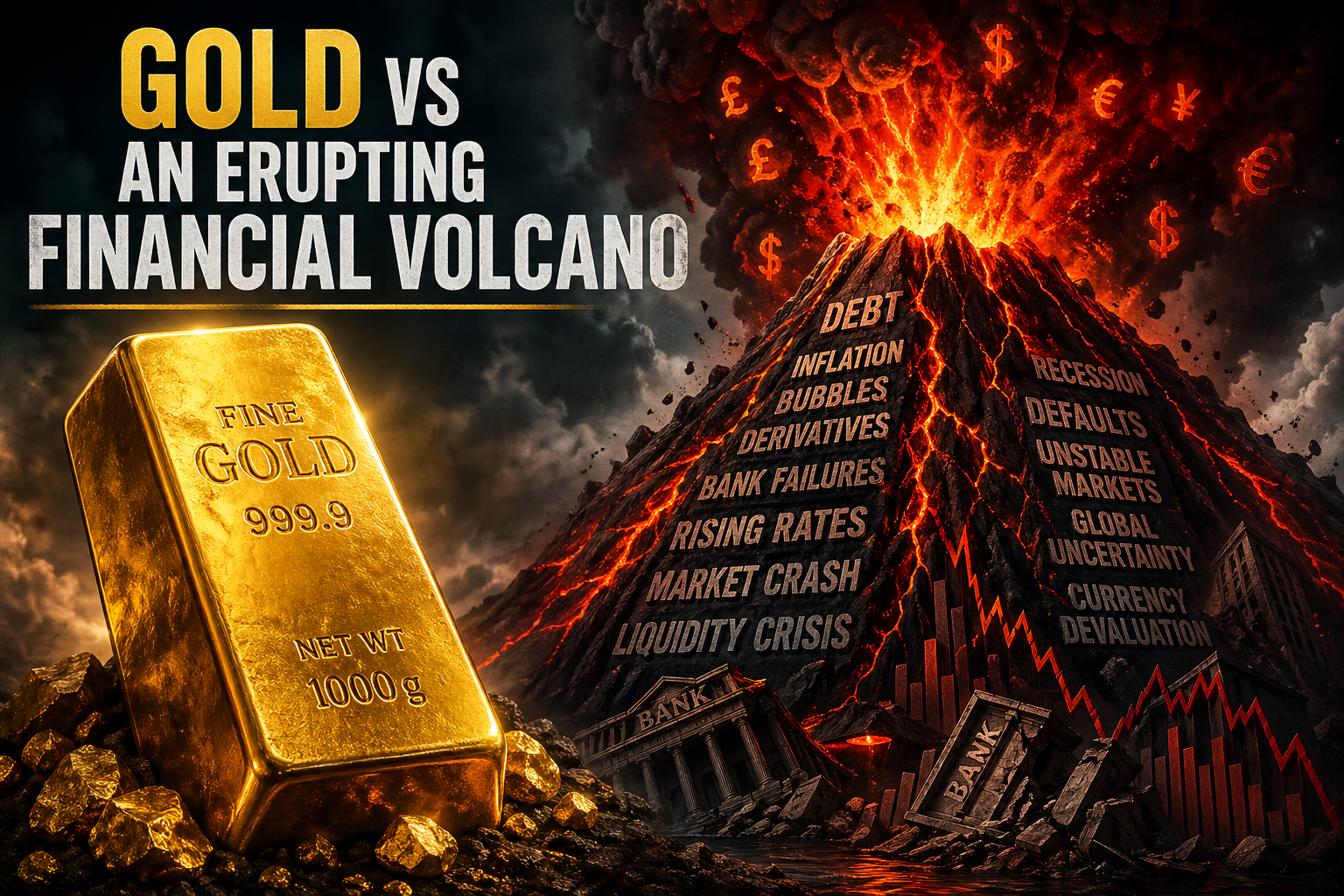
The article uses the metaphor of a financial volcano to describe the current macroeconomic landscape. While markets may appear calm on the surface, underlying fissures—particularly within sovereign debt, energy systems, and liquidity conditions—are expanding. These pressures are not random but structural, reflecting long-term imbalances that have accumulated through decades of monetary expansion and policy intervention.
Within the gold vs erupting financial volcano analysis, oil is presented as a key transmission mechanism of economic stress. Energy markets are portrayed not as suffering from simple scarcity, but from constrained flows shaped by geopolitical tension, financial constraints, and supply reallocation. Because oil directly influences transportation, production, and food systems, its price volatility rapidly propagates inflationary pressure throughout the global economy. This makes oil a central accelerant in systemic instability.
Debt is identified as the core structural vulnerability underlying the entire system. The analysis emphasizes that global economies have reached levels of indebtedness that cannot be sustained through organic growth or conventional repayment. As a result, policymakers are forced into cyclical strategies of currency devaluation and debt repricing. Rising interest rates, even in weakening economic conditions, are interpreted as part of this adjustment mechanism, effectively redistributing and revaluing debt burdens rather than stabilizing inflation in a traditional sense.
The gold vs erupting financial volcano analysis highlights the bond market as a critical signal of systemic strain. Increasing sovereign yields across major economies indicate declining demand for government debt and rising concerns about fiscal sustainability. As borrowing costs rise, highly indebted states face compounding pressure, reinforcing the feedback loop between debt servicing, currency weakness, and monetary expansion. This dynamic is particularly acute in economies with large outstanding obligations.
Private credit markets are also identified as an emerging stress point. The lack of transparency, reliance on internal valuation models, and restricted liquidity create conditions where financial risk may be underestimated until redemption pressures force repricing. This mirrors earlier crisis cycles where stress first appeared in opaque segments of the financial system before spreading more broadly.
Gold, in contrast, is positioned as the system’s stabilizing counterweight. In the gold vs erupting financial volcano analysis, gold is no longer framed as a passive hedge but as a re-emerging monetary benchmark. As trust in sovereign debt instruments erodes, capital increasingly shifts toward assets that are not simultaneously liabilities within the financial system. However, gold is acknowledged to experience short-term volatility during liquidity crunches, when cash demand temporarily forces broad asset liquidation.
Liquidity cycles are central to the framework. Periods of dollar strength, rising yields, and asset sell-offs are interpreted as transitional phases within a broader debt-adjustment process rather than structural reversals. Once liquidity stabilizes, underlying drivers—debt expansion, currency debasement, and monetary accommodation—reassert themselves, supporting gold’s longer-term trajectory.
Ultimately, the gold vs erupting financial volcano analysis concludes that the global financial system is entering a more fragile phase than previous cycles due to elevated debt levels and reduced policy flexibility. This limits the system’s ability to absorb shocks without further monetary distortion. In this environment, gold is positioned as a primary form of financial insulation, serving as protection against systemic repricing of both debt and currency. The broader implication is that current volatility is not cyclical noise, but the visible expression of a long-building structural transition.
BMG Note: Gold & Silver Opportunity
The current macro environment reinforces a structural shift in monetary metals, driven by rising sovereign debt, persistent inflation pressures, and increasingly fragile bond and liquidity markets. In this setting, both gold and silver are reasserting their roles, but in distinct and complementary ways.
Gold continues to function as the primary monetary hedge against systemic risk. As confidence in sovereign debt and fiat currencies erodes, capital is steadily migrating toward assets without counterparty exposure. In periods of liquidity stress, gold’s role as a reserve-grade store of value becomes more pronounced, particularly as financial assets undergo broad repricing.
Silver, however, presents a more asymmetric opportunity within the same framework. It retains its historical monetary linkage to gold but adds a powerful industrial demand component. Electrification, solar expansion, and broader technological deployment are tightening physical supply conditions at the same time as above-ground inventories remain limited. This dual demand profile creates structural sensitivity to both monetary debasement cycles and industrial growth trends.
Importantly, silver tends to lag gold in early phases of monetary stress but often outperforms once investment demand broadens and momentum builds. Its higher volatility reflects this delayed but amplified response dynamic.
Short-term liquidity events will continue to create volatility across both metals, particularly during cash-driven market stress. However, these periods are consistent with late-cycle debt dynamics and have historically provided strategic accumulation opportunities rather than trend reversals.
For positioning, gold remains the foundational defensive asset within a portfolio framework focused on capital preservation. Silver, meanwhile, represents the higher-beta expression of the same macro thesis, offering greater upside potential tied to both monetary repricing and structural industrial demand.
In a system defined by rising debt burdens and constrained policy flexibility, the opportunity in monetary metals is no longer singular. Gold provides stability. Silver provides leverage.